


Batch 13
Professional Certificate Programme in Data Science and AI for Business
Apply Data Science, GenAI & Agentic AI to Business Decisions, Workflows and Applications
- Live Masterclasses by Industry Experts
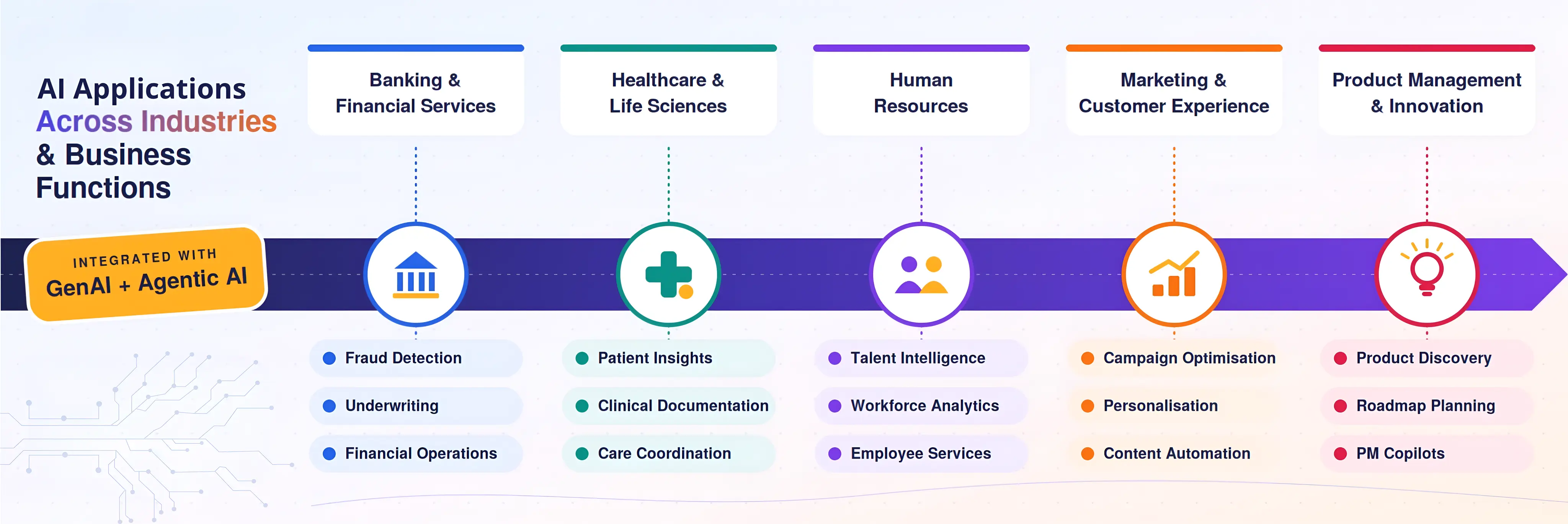
- AI Applications Across Industries & Business Functions
Avail early enrollment benefits of Invalid liquid databefore Invalid liquid data
What Is the IIM Kozhikode Data Science and AI Programme for Business?
The Professional Certificate Programme in Data Science and AI for Business is a 7 months online programme from IIM Kozhikode covering Data Science, business analytics, Machine Learning, Generative AI, and Agentic AI. Priced at 1,89,000 + GST, the curriculum combines depth in business analytics, forecasting, and AI/ML model evaluation with broader coverage of enterprise GenAI, Agentic AI workflows, cross-industry applications, and responsible AI adoption.
The programme brings together Data Science, Machine Learning, Generative AI, and Agentic AI to improve business decisions, optimise workflows, address real-world challenges, and support responsible enterprise adoption. Participants learn through pre-recorded modules by IIM Kozhikode faculty, live industry expert masterclasses, real-world use cases, two applied mini projects, and a Strategy & Integration Capstone.
Key Learning Areas in the Data Science and AI Programme
Comprehensive Coverage: Data Science, AI, ML, GenAI, and Agentic AI to improve decisions, workflows, and business outcomes.
Business-Focused Analytics: Dashboards, forecasting, and AI/ML model evaluation to improve decision-making.
Enterprise GenAI & Agentic AI: GenAI solutions, agentic systems, workflows, and orchestration to enhance business processes and productivity.
Cross-Industry Applications: Banking, healthcare, HR, marketing, customer experience, and product management
Enterprise AI Adoption: AI platforms, operating models, integration, governance, risk, and responsible AI
IIM Kozhikode Data Science and AI Course Highlights

Comprehensive Coverage from Data Science to Agentic AI
Build capabilities across Data Science, analytics, AI, Machine Learning, Generative AI, and Agentic AI.

23 Pre-recorded Modules by IIM Kozhikode Faculty
Learn flexibly through structured modules spanning analytics, AI applications, and business transformation.

Live Masterclasses led by Programme Leader
Gain applied exposure to analytics, Python, visualisation, enterprise AI tools, and agentic workflows.

Projects & Strategy Integration Capstone
Apply analytics, GenAI, and Agentic AI through mini projects and an enterprise AI integration plan.

AI Applications Across Industries & Business Functions
Explore applications across banking, healthcare, HR, marketing, customer experience, and product management.

IIM Kozhikode Certificate of Completion
Earn a certificate of completion from IIM Kozhikode upon successfully meeting the programme requirements.

Explore 15+ Data, AI & Automation Tools
Gain exposure to contemporary tools for analytics, GenAI, visualisation, and workflow automation.

On-Campus Networking at IIM Kozhikode
Connect with peers through an optional one-day networking experience at the IIM Kozhikode campus.*
Note: -
The final number of quizzes, assignments and discussions will be confirmed closer to the programme start.
This is a self-paced online programme. Thus, faculty will not be a part of weekly live sessions or any other live interaction in this programme. We have a curated panel of eminent industry practitioners who will be conducting the weekly live doubt-clearing sessions.
*The pre-recorded demo videos are optional and will not be factored into your final evaluation.
Programme leader is the industry expert responsible for conducting the live masterclasses.
The optional on-campus networking event is a one-day programme that allows learners to connect with peers from different cohorts at the IIMK Campus. The fee for this event is INR 13,000 per day as the optional in-campus fee for twin-sharing mode of accommodation and Rs. 15,000 per day for single accommodation.
Who Should Enrol in the IIM Kozhikode Data Science and AI Programme?
This online Data Science and AI programme is designed for managers, Data and AI professionals, technology and transformation professionals, functional professionals, business leaders, consultants, and entrepreneurs seeking to apply Data Science, Machine Learning, Generative AI, and Agentic AI to business challenges.
Mid-to-Senior-Level Managers: Senior, Project, Programme, Delivery, Team, and Business Managers seeking to apply Data Science and AI to solve complex business problems and improve decision-making.
Data, AI & Analytics Professionals: Data Scientists, AI/ML Professionals, Analysts, Analytics Managers, BI Professionals, and Automation Leads seeking to connect technical capabilities with business priorities and enterprise value.
Technology, Functional & Transformation Professionals: Technology, Product, Automation, and Transformation professionals, along with managers across Finance, Operations, Customer Experience, Marketing, HR and Strategy, seeking to improve workflows, functional performance, and enterprise AI adoption.
Business Leaders, Consultants & Entrepreneurs: VPs, Directors, General Managers, Business Unit Heads, Consultants, Founders, and Business Owners seeking to evaluate AI opportunities, drive transformation, or create AI-enabled offerings and business models.
Note : Basic understanding of mathematics and statistics is recommended for the programme.
Explore AI Applications Across Industries & Business Functions
What Does the IIM Kozhikode Data Science and AI Curriculum Cover?
Pillar 1: Introduction
Module 1: Foundation: Data Science & AI Overview
Programme overview, structure, and deliverables
Role of Data Science & AI in modern organisations
Evolution of analytics → ML → AI in business contexts
Conceptual refresher on mathematical intuition (data, uncertainty, optimisation — non‑formulaic)
Overview of the modern DS & AI tool landscape (Python, analytics stacks, cloud platforms — conceptual)
Pillar 2: Data Science
Module 2: Introduction to Data Analytics & Data‑Driven Decision Making
Data-Driven Decision Making
Types of analytics: descriptive, diagnostic, predictive, prescriptive
Business problems vs analytical problems
Data Types and Their Comparison
Data Categories
Data Cycle
Analytical Thinking Models
Module 3: Data Cleaning, Preparation & Quality Management
Understanding Data
Types of Attributes
Data Sources and Data Quality - May need refilming for complexity
Data Cleaning
Identifying Outliers
Measures of Centre and Spread
Data Exploration: Hypothesis Testing Vs. Exploratory Data Analysis
Data Transformation
Data Scaling
Data Transformation for Normality
Module 4: Exploratory Data Analysis & Data Visualization
What is Data Visualisation and Why is it Important?
Design Principles: Pre-attentive Attributes
Tidy Data Principles
Introduction to Basic and Advanced Charts
4C Principles
Dashboard Design
Exploratory Vs. Explanatory Dashboards
Colour Theory
The Use of Colour in Data Visualisation
Colour Vision Deficiency
Creating a Colour Palette
Module 5: Dashboards, Metrics & Performance Analytics
KPIs, metrics, and OKRs
Designing dashboards for different stakeholders
Operational vs strategic dashboards
Interpreting dashboards for decision‑making
Common pitfalls in dashboard‑driven management
Module 6: Statistical, Predictive and Prescriptive Analytics for Managers
Statistical intuition: variability, correlation vs causation
Confidence, uncertainty, and risk interpretation
Introduction to predictive analytics and forecasting (non-technical)
Use cases of predictive analytics in business
Introduction to prescriptive analytics
Use cases of prescriptive analytics
Pillar 3: AI/ML Concepts
Module 7: Introduction to Artificial Intelligence
Basics of Artificial Intelligence
Importance of AI
Evolution of AI
Classification of AI
Generative AI
Risks and Limitations of AI
Transformation of Future Job Roles by AI
Module 8: Introduction to Machine Learning
Machine Learning Concepts
General Learning: Levels of Learning
Machine Learning Approaches
Supervised Learning
Unsupervised Learning
Reinforcement Learning
Deep Learning
Deep Learning Approaches
Machine Learning: A Holistic View
Introduction to MLOps
Module 9: Supervised & Unsupervised Learning and Reinforcement Techniques for Managers
Problem framing: prediction vs pattern-discovery
Classification and regression models
Model intuition (no math): simple intuition for how systems learn from past examples
Success metric for the business goal (reducing losses, improving accuracy, improving customer experience)
Recognising common pitfalls in data projects: biased data, misleading correlations, wrong signals, over-complex models
Clustering for sense-making: segmentation (conceptual), business validation
Real-world applications: customer segmentation, churn flags, fraud alerts, product grouping, early-warning systems
Reinforcement learning
Real-world applications of reinforcement learning
Module 10: Strategic Forecasting, AI/ML Model Evaluation for Business
Understanding when “forecasting” matters: planning for demand, revenue cycles, staffing, inventory, and risk
Recognising patterns in business data: trends, seasonal effects, sudden shifts
Explainability (concepts): global vs local explanations; when/why explanations are necessary
Evaluating AI/ML models using business-friendly metrics: linking model performance to ROI, customer outcomes, efficiency gain
Operating norms: human oversight, override/escalation rules, accountability & audit trails
Pillar 4: GenAI Concepts
Module 11: Foundations of Language Models & Prompting
Foundations of Natural Language Processing
Tokens, tokenization, and embeddings: what they represent and why they matter
Foundations of Large Language Models (LLMs): transformer intuition (non-technical)
SLMs vs LLMs
Prompting patterns: zero-shot, few-shot, role-based prompts, chain-of-thought (conceptual)
Prompt hygiene and instruction quality for reliable outputs
Context windows: limits, trade-offs, and design implications
Cost drivers in GenAI systems: tokens, latency, caching considerations
Strengths and limitations of LLMs in business contexts
Module 12: GenAI Solutions for the Enterprise
Choosing the right approach for each use case
Workflow design over model tuning: map the business process
Business evaluation of GenAI pilots: define success in time saved, error reduction
Trade-offs between open ecosystems (flexibility, cost, customization) and managed platforms (speed, security, support)
Scale-up playbook: from pilot → playbook → SOP → training, performance dashboards for leaders
Pillar 5: Agentic AI Concepts
Module 13: Agentic AI Foundations, Planning & Tool Use
Introduction to Agentic AI: why agents are different
Task planning, decomposition, and goal-oriented reasoning (conceptual)
Tool use in agents: functions, APIs, search, and external systems
Orchestration frameworks: coordinating steps, tools, and decisions
Memory types in agentic systems: short-term, long-term, and contextual memory
Module 14: Agentic Systems: Agentic AI & Emerging Platforms
Emerging Agentic Platforms
Single-agent vs multi-agent systems: patterns and trade-offs
Open-Source vs Closed-Source AI Systems
Agentic Analytics
Agent Marketplaces & Plug-and-Play Workflows
Business Process Re-Design with Agents
Measuring Value & Impact of Agent Systems
Pillar 6: AI Applications Across Industries
Module 15: AI, GenAI & Agentic AI in Banking & Financial Services
Credit scoring, fraud detection, AML, risk modelling (traditional AI/ML)
GenAI for customer service, report generation, underwriting support
Agentic AI for loan processing, dispute resolution, financial ops automation
Regulatory constraints, explainability, model risk management
Case studies: Retail banking, payments, NBFCs
Module 16: AI, GenAI & Agentic AI in Healthcare & Life Sciences
Predictive analytics for diagnosis, patient risk stratification
Computer vision in medical imaging (conceptual)
GenAI for clinical documentation, research summarisation, patient engagement
Agentic AI for care coordination, clinical workflow orchestration
Data privacy, ethics, and regulatory considerations (HIPAA-like contexts)
Module 17: AI, GenAI & Agentic AI in Human Resources (HR)
Talent acquisition & recruiting intelligence: AI-assisted screening, skills-based shortlisting, personalized outreach, bias-aware practices
Workforce analytics & employee insights: attrition risk signals, engagement drivers, skills gap mapping, capacity planning for headcount & shifts
GenAI for HR documentation & knowledge automation
Agentic AI for HR workflows & employee services: onboarding assistants, HR helpdesk/benefits Q&A
Module 18: AI for Digital Marketing, Growth & Customer Experience
Content automation
Segmentation & targeting
Campaign optimisation
Attribution modeling
Personalisation engines
Generative brand assets
Module 19: AI for Product Management, Innovation & Tech Strategy
AI-augmented product discovery
Requirements generation
Roadmap planning
Experimentation frameworks
User research automation
PM copilots
Pillar 7: AI Business Transformation
Module 20: AI-First Business Models & Value Creation
AI as a growth, efficiency, and innovation engine
AI-first vs AI-enabled organizations
Platform and ecosystem-based business models
Data moats and network effects
Mapping AI use cases to strategic objectives
Case examples of AI-driven value creation
Module 21: AI Operating Models, Organization & Change
Centralized CoE vs federated AI operating models
Product-led AI vs project-based analytics
Key AI roles: AI PM, Data Scientist, ML/AI Engineer, Business Translator
Business–IT–AI collaboration models
AI talent planning and capability roadmaps
AI value measurement, adoption metrics, and ROI
Change management and leadership communication
Module 22: Enterprise Data, AI Platforms & AI/Agentic Integration
Modern enterprise data platforms and lakehouse concepts
Data products, domain ownership, and data mesh principles
Enterprise AI stacks incl. GenAI and RAG (conceptual)
Embedding AI into enterprise workflows
Batch vs real-time AI integration patterns
Agentic AI Systems
Module 23: AI Governance, Risk, Policy & Responsible AI
AI governance frameworks & oversight models
Responsible AI: fairness, transparency, accountability, safety
Regulatory landscapes (DPDP Act India, EU AI Act, managerial lens)
Enterprise AI oversight: committees, review boards, risk processes
GenAI-related risks: IP, data leakage, compliance
Case studies on AI failures & governance best practices
Pillar 8: Mini Projects
Module 24: Hands-on Mini Projects
Mini Project 1:
Hands-on Analytics-Business Dashboard Challenge (Post Data Science Pillar)
Mini Project 2:
GenAI Workflow Automation & Agentic AI Prototype (Post GenAI + Agentic AI Pillars)
Pillar 9: Capstone
Module 25: Strategy & Integration Capstone
Enterprise integration plan: value sizing, adoption roadmap, governance & controls, talent plan, communication pack for leadership
Note:
Modules/ topics are indicative only, and the suggested time and sequence may be dropped/ modified/ adapted to fit the total programme hours.
You will have access to the online learning platform, including all videos and programme materials, during the course and for one year after the programme end date. Access to the platform is restricted to registered participants, as per the terms of the agreement.
Data, AI and Automation Tools Covered in the Data science and AI Programme?











Note:
All product and company names mentioned in this material are trademarks or registered trademarks of their respective holders. Their use does not imply any affiliation with or endorsement by them.
The tools and platforms mentioned are subject to change and will be finalized prior to the start of the programme.
What Do Learners Say About the IIM Kozhikode Data Science and AI Programme?
Learner reviews consistently describe the IIM Kozhikode Professional Certificate Programme in Data Science and Artificial Intelligence for Business as a highly structured, transformative learning experience that bridges management expertise with data-driven decision-making. Participants highlight that the curriculum is thoughtfully designed, covering both foundational and advanced concepts in Data Science, AI, and Machine Learning while maintaining accessibility for professionals from non-technical backgrounds.
The programme is praised for its clarity of instruction, hands-on learning, and future-oriented insights into AI’s evolving role in business. Faculty members are consistently commended for their expertise, approachability, and ability to simplify complex topics through real-world examples and guided projects. Many reviewers note that the learning journey not only strengthened their analytical and technical capabilities but also broadened their strategic understanding of how AI can drive business outcomes.
Participants also appreciated the structured learning materials, responsive support team, and peer discussions, which together created a seamless and engaging learning environment.
Key Takeaways Mentioned by Participants
A well-structured, comprehensive curriculum suitable for professionals from diverse fields.
Expert faculty with deep knowledge and a practical approach to AI and data science.
Strong emphasis on hands-on projects and real-world business applications.
Enhanced analytical, problem-solving, and data interpretation skills.
Exposure to the future scope and strategic impact of AI/ML in industry.
Supportive learning ecosystem with responsive faculty and support teams.
What Do Past Participants Say About the IIM Kozhikode Data Science and AI Programme?
Programme Directors of Data Science and AI for Business Course

Prof. M.P. Sebastian, PhD
Prof. M.P. Sebastian, PhD Professor, Information Systems
Professor Sebastian received both his masters degree and PhD from the Indian Institute of Science, Bangalore. His research interests include artificial intelligence, machine l...

Prof. Vidushi Pandey
Associate Professor, Information Systems, IIMK
Prof. Vidushi Pandey holds a Ph.D. in Information Systems and specializes in Social Media, Data Analytics, and Digital Business. With a decade of experience as a researcher an...
Meet the Programme Leader of Data Science and AI Programme

Dr. Partha Majumdar
Dr. Partha Majumdar is an accomplished programmer who has contributed to the development of more than ten enterprise-class products deployed across customer locations in over ...

Mr. Atul Bengeri
A seasoned professional with over 24 years of experience in Digital Transformation, with extensive expertise in the design, development, and deployment of products, solutions,...
Note:
The above industry leader profiles are indicative in nature, and the final profiles in the programme may vary.
Programme leader is the industry expert responsible for conducting the live masterclasses.
What Will You Learn in the IIM Kozhikode Data Science and AI Programme?
This data science and artificial intelligence course develops business-focused capabilities across analytics, Machine Learning, Generative AI, Agentic AI, and enterprise AI adoption. Participants will learn to:
Develop data-driven decision-making capabilities using analytics, dashboards, KPIs, forecasting, and business intelligence frameworks.
Evaluate and apply Data Science, AI, Machine Learning, Generative AI, and Agentic AI use cases across business functions and industries.
Assess AI initiatives through a business lens, considering value potential, performance metrics, operational feasibility, and organisational priorities.
Apply analytics and AI frameworks through applied projects and a strategy-focused capstone to address real-world business challenges.
Identify, prioritise, and scale AI opportunities aligned with organisational strategy and business objectives.
Lead AI-enabled business transformation initiatives while addressing adoption, governance, risk, change management, and responsible AI considerations.
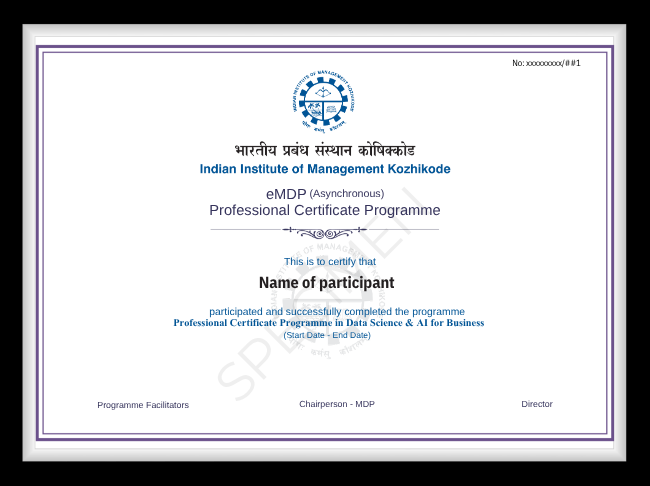
Programme Certificate
Upon successful completion of the programme, eligible participants earn a certificate from IIM Kozhikode. This Data Science and AI certification programme enables professionals to demonstrate learning across Data Science, Machine Learning, Artificial Intelligence and Generative AI.
IIM Kozhikode will award a certificate of successful completion to participants who complete the programme successfully with 70% of the score in the evaluation. A participant with less than 70% of the score in the overall evaluation will not be awarded any certificate.
Note: All certificate images are for illustrative purposes only and may be subject to change at the discretion of IIM Kozhikode.
Past Participant Profiles
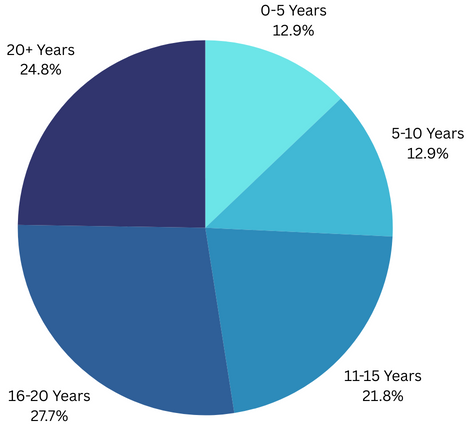
Work Experience
Top Industry
IT/ Computers
Banking
Financial Services
Healthcare
Consumer Products/Retail
Past Participants of Emeritus work at













The Learning Experience
Join a global community of 300,000+ professionals across 200 countries who have advanced their careers with Emeritus. In a recent survey, 9 out of 10 learners said their expectations were met or exceeded.
From day one, you’ll get access to carefully designed course material, live interactions, and a structured cohort-based journey that keeps you on track. Our approach blends flexibility with accountability—so you don’t just start, you finish strong.
And you’re never on your own. A dedicated program support team is available 7 days a week to guide you with platform queries, technical support, or any learning-related questions—so you can focus on what really matters: your growth.
A dedicated programme support team is available 7 days a week to answer questions about the learning platform, technical issues, or anything else that may affect your learning experience.
.
FAQ's About IIM Kozhikode Data Science and Artificial Intelligence Course
What is the IIM Kozhikode Data Science and AI course?
The data science and artificial intelligence online courses is a 7-month online programme designed to help managers and business professionals apply Data Science, Machine Learning, Artificial Intelligence and Generative AI to business decisions.
What are the eligibility requirements for the IIM Kozhikode Data Science and Artificial Intelligence for Business course?
The eligibility requirements for the IIM Kozhikode Data Science and AI for Business Programme include a bachelor's degree in any discipline. Although no mandatory work experience is required, having a professional background in a related field such as data science or AI would be advantageous.
Who should apply for the IIM Kozhikode certification in Data Science and AI for Business ?
The data science and artificial intelligence courses is designed for working professionals in mid- to senior management roles who want to build their expertise in data science, machine learning, and artificial intelligence. It is particularly suited for decision-makers who want to leverage data-driven insights and AI techniques to enhance their strategic and operational capabilities.
What does the curriculum of the IIM Kozhikode Data Science and AI for Business Programme cover?
The curriculum covers key areas such as data analysis, statistical methods, machine learning, deep learning, AI applications, and more. Participants will engage in practical, hands-on learning through projects and case studies, ensuring they develop real-world expertise in data science and AI. This data science AI course is designed to be one of the most comprehensive data science classes available.
Is the IIM Kozhikode Data Science and Artificial Intelligence for Business Programme delivered live or through recorded sessions?
The IIM Kozhikode Data Science and Artificial Intelligence for Business Programme is delivered through recorded video sessions, offering flexibility for participants to learn at their own pace. This allows them to balance their professional and personal commitments while taking these data science classes.
What is the fee for the IIM Data Science and Artificial Intelligence for Business Programme?
The fee for the IIM Kozhikode Data Science and AI for Business Programme is INR 1,89,000 + GST. This includes access to all course materials, recorded video lectures, and the certification upon completion. For those comparing data science course fees, this fee reflects the programme's comprehensive content and the prestige of an IIMK certification.
Is there a financing or installment option available for the IIM Kozhikode course in Data Science and AI for Business?
Yes, there are financing options available in this data science machine learning course, including the possibility of paying the course fee in instalments. This makes the data science and AI certification course accessible to a broader range of participants, especially those who might be concerned about data scientist course fees.
What tools will be covered in the IIM Kozhikode Data Science and Artificial Intelligence for Business Programme?
This data science machine learning course will cover a variety of industry-standard tools and technologies, such as Python, R, TensorFlow, Keras, and more. These tools are essential for conducting data analysis, building machine learning models, and applying AI techniques in various business contexts, making it a highly practical data science course.
Why is this IIM Kozhikode course considered the best in Data Science and Artificial Intelligence for Business?
This data science with gen AI course is highly regarded because it offers a blend of theoretical knowledge and practical application, delivered by experienced IIM Kozhikode faculty. The programme’s comprehensive curriculum is designed to equip mid to senior level managers with the skills needed to implement data-driven strategies and make informed decisions in an AI-driven business environment. When evaluating data science course options, this one stands out among many AI courses in Kozhikode for its depth and focus on managerial applications
What is the scope of Data Science and Artificial Intelligence in business?
Data Science and Artificial Intelligence are applied across industries and business functions to improve decision-making, forecast outcomes, automate workflows, personalize experiences, and support innovation. Their scope now extends from analytics and Machine Learning to Generative AI, Agentic AI, enterprise integration, governance, and responsible AI adoption.
Does this data science and AI programme cover Machine Learning, Generative AI and Agentic AI?
Yes. The curriculum covers Machine Learning approaches, business-focused model evaluation, Large Language Models, prompting, enterprise GenAI solutions, and Agentic AI systems and workflows. Participants also explore applications across industries and business functions, along with enterprise AI integration, governance, risk, and responsible AI adoption.
Elevate your career with this programme!
Flexible payment options available.
Starts On